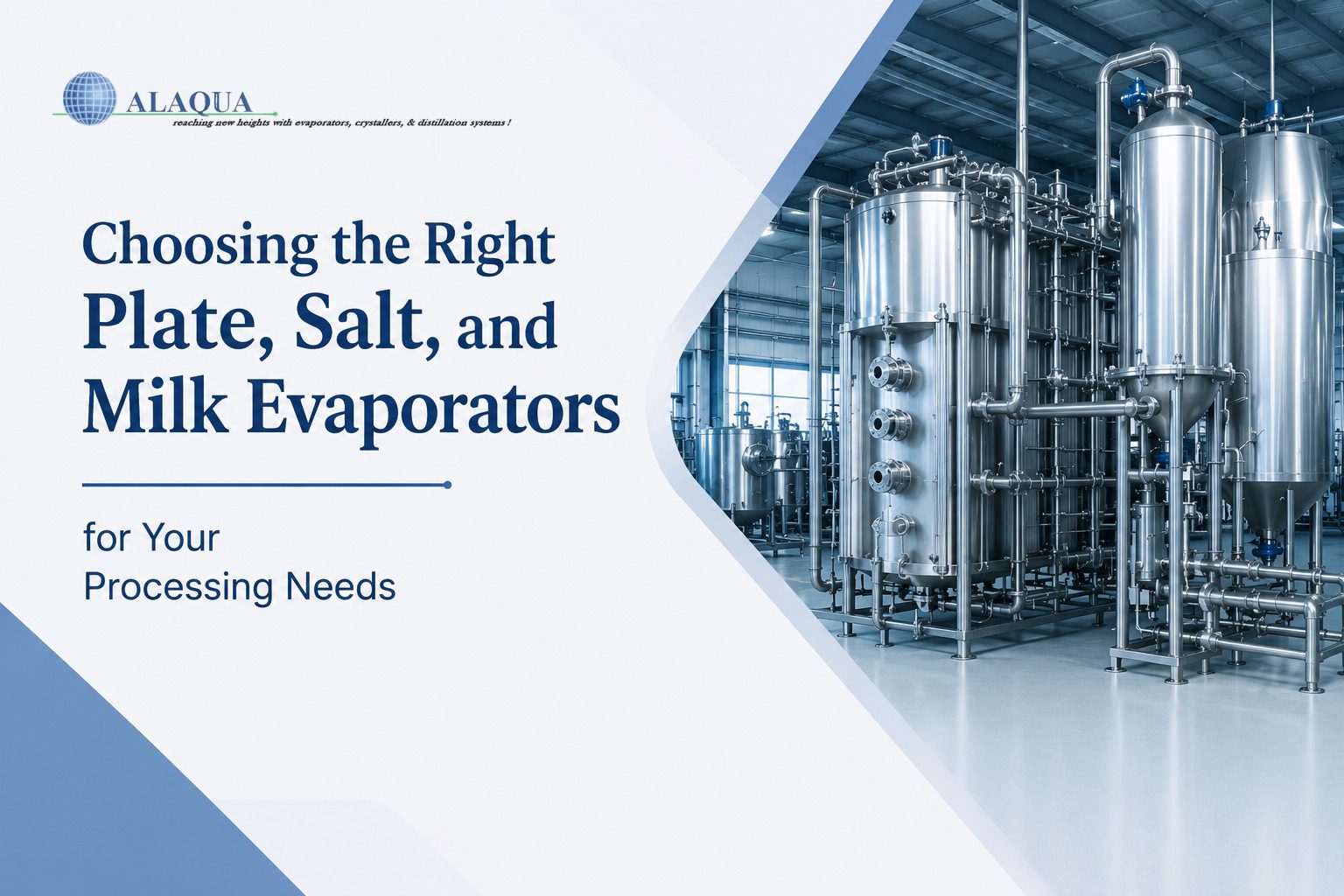
Plate evaporators, salt evaporators, and milk evaporators are three of the most widely used pieces of process equipment in modern manufacturing, and choosing the right one can make a measurable difference in product quality, energy costs, and plant uptime. If your facility handles dairy products, brine, or any liquid stream that needs to be concentrated efficiently, understanding how these systems differ is the first step toward a smarter capital investment.
Alaqua Inc. is a US-based manufacturer and supplier of industrial evaporators, crystallizers, distillation systems, and spray dryers, headquartered in Guttenberg, New Jersey. The company designs and supplies equipment for the chemical, environmental, food, pharmaceutical, and power generation industries, offering everything from falling film and forced circulation evaporators to solvent recovery systems and heat exchangers. Alaqua’s approach is single-source responsibility, meaning the company handles initial consultation, equipment supply, and supervision of installation, start-up, and commissioning under one roof, so plant engineers are not left coordinating between multiple vendors.
For a free consultation on which evaporator technology fits your process, call Alaqua Inc. at +1 551-482-7568 or email info@alaquainc.com.
What Makes Plate Evaporators Different
Plate evaporators use framed plates instead of the traditional tube-and-shell arrangement found in older evaporator designs. A product plate and a steam plate are connected alternately, with the product passage engineered for even liquid distribution and low pressure drop on the vapor side. This construction gives plate evaporators a compact footprint, with unit heights typically staying under 20 to 25 feet, which means they can be installed inside most existing buildings without major structural changes.
One of the biggest practical advantages of plate evaporators is serviceability. Because the plate package opens easily, operators can inspect heat transfer surfaces, swap out individual plates, and even adjust total evaporation capacity by adding or removing plates from the stack. For facilities running dairy products, plate evaporators can also be built to meet USDA sanitary design requirements, which matters a great deal for food-grade processing lines that undergo regular audits.
Why Salt Evaporators Matter in Industrial Processing
Salt production, chemical manufacturing, and industrial wastewater treatment all share a common challenge: pulling dissolved salt out of a liquid stream in a way that is both efficient and consistent. Salt evaporators are engineered specifically for this job, concentrating brine or process liquor until the dissolved salts crystallize out as a usable solid product.
These systems typically rely on forced circulation technology to avoid the fouling and scaling problems that plague less specialized equipment. Because the flow velocity through the tubes is kept high with dedicated recirculation pumps, salt build-up on the heat transfer surfaces is minimized, which keeps thermal efficiency high over longer production runs. This is also why salt evaporators are frequently paired with crystallizers in zero-liquid-discharge (ZLD) applications, where the goal is to recover both clean water and a solid salt by-product rather than sending anything to waste. Readers who want a deeper technical breakdown can review Alaqua’s blog on the Salt Evaporator: What It Is and How It Works.
The Role of Milk Evaporators in Dairy Processing
Milk evaporators are built around a very different priority: protecting a heat-sensitive product while still removing large volumes of water efficiently. Dairy processors rely on falling film and rising film evaporator technology because these designs allow milk to pass through the heating surface quickly, with short residence times measured in seconds, which limits the risk of scorching, protein denaturation, or flavor loss.
A properly engineered milk evaporator system also needs to meet 3A sanitary standards, support clean-in-place (CIP) procedures, and often incorporates thermal vapor recompression (TVR) or mechanical vapor recompression (MVR) to reduce steam and electricity consumption across multi-effect configurations. Compact, skid-mounted milk evaporators are increasingly popular for mid-size dairy and beverage operations because they arrive pre-assembled, require minimal foundation work, and can handle up to roughly 20,000 lbs/hr of water removal while operating at boiling temperatures as low as 115°F.
How Alaqua Builds Trust Through Engineering Experience
Alaqua’s experience spans a genuinely broad list of applications, including juices, whey, yogurt, gelatin, glucose, lactose, citric acid, ammonium sulfate, and dozens of other product streams, which reflects years of hands-on engineering work across food, pharmaceutical, and chemical sectors. Every system is custom-supplied to ASME and CE requirements, and the company’s services extend well beyond equipment supply to include basic and detailed engineering, fabrication, operator training, installation and commissioning, and retrofitting of existing plants.
This full lifecycle involvement, from the first engineering consultation through startup support, is what separates a true process equipment partner from a simple equipment vendor. For readers researching related topics, Alaqua’s blog also covers What a Pump Evaporator Is and How Does It Work? and Cooling Crystallizer: What It Is and How It Works, both useful companion reads for anyone evaluating a full evaporation and crystallization system.
Choosing the Right System for Your Process
The right choice between plate evaporators, salt evaporators, and milk evaporators comes down to the product being processed, the required throughput, available floor space, and long-term energy costs. Plate evaporators tend to suit facilities that need a compact, easily serviced unit. Salt evaporators are the natural fit for brine concentration and ZLD projects. Milk evaporators are purpose-built for dairy and other heat-sensitive liquid foods. In many cases, a combination of these technologies, supported by the right heat exchangers and instrumentation, delivers the best balance of product quality and operating cost.
Frequently Asked Questions
Q1. What industries commonly use plate evaporators?
Ans: Plate evaporators are widely used in dairy, food, beverage, and chemical processing where a compact footprint and easy plate inspection are priorities.
Q2. Can salt evaporators be combined with crystallizers?
Ans: Yes, salt evaporators are often paired with evaporative or forced circulation crystallizers, especially in zero-liquid-discharge systems designed to recover both water and solid salt.
Q3. Are milk evaporators safe for heat-sensitive dairy products?
Ans: Milk evaporators use falling film or rising film technology with short product contact times, which is specifically designed to protect heat-sensitive dairy products from thermal damage.
Q4. Does Alaqua, Inc. provide installation and training along with the equipment?
Ans: Yes, Alaqua Inc. offers single-source responsibility that includes engineering, fabrication, installation, commissioning, and operator training for every system supplied.
Q5. How do I get a quote for an evaporator or crystallizer system?
Ans: You can request a free consultation and get a quote by calling Alaqua Inc. at +1 551-482-7568 or emailing info@alaquainc.com, and the team will help identify the right system for your process.
Conclusion
Selecting the right evaporation technology is rarely a one-size-fits-all decision. Plate evaporators, salt evaporators, and milk evaporators are each engineered around a different priority, whether that is a compact footprint, resistance to fouling and scaling, or protecting a heat-sensitive product during concentration, and getting that choice right has a direct impact on product quality, energy consumption, and long-term maintenance costs. This is precisely why working with a manufacturer that understands the full process, from initial engineering through fabrication, installation, and operator training, matters as much as the equipment itself.
Alaqua Inc. brings decades of combined engineering experience to every plate evaporator, salt evaporator, and milk evaporator project, backed by single-source responsibility that covers consultation, equipment supply, and startup support. Whether you are upgrading an aging dairy line, adding a zero-liquid-discharge system for brine recovery, or specifying a compact plate evaporator for a new facility, the Alaqua team can help match the right technology to your process conditions and budget. To discuss your requirements or request a free consultation and get a quote, call +1 551-482-7568 or email info@alaquainc.com today.