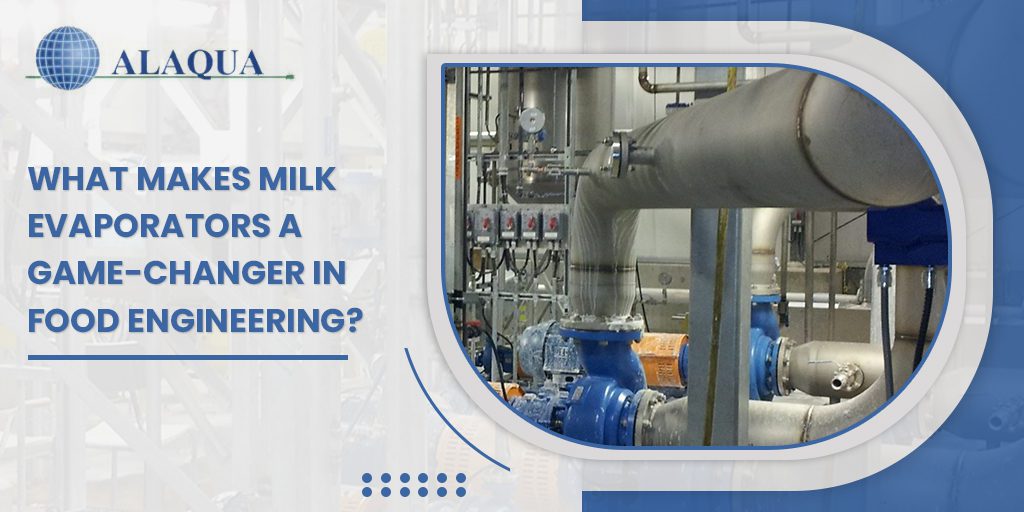
You can go into any modern dairy plant, and you will see the whole scenario changed. It does not feel like the old idea, like “milk processing,” anymore, but it feels closer to a precision lab where stainless steel systems are humming quietly, sensors are adjusting in real time, and the milk is moving through a tightly controlled transformation process altogether. And the hero of the transformation—the milk evaporator.
It is not flashy or consumer-facing but really important. Companies like ALAQUA are specialized providers in the USA for whom milk evaporators are more than just machines, who offer other machines like salt evaporators, crystallizers & distillation systems as well. For us, these are not just machines but engineered solutions that reshape the entire dairy world.
Milk Isn’t Just “Reduced” Anymore—It’s Engineered
In old times, milk concentration meant just to remove the water from it, but modern food engineering has changed it all—now controlled transformation is the goal. An evaporator for milk carefully removes the moisture from milk while preserving the following:
- Protein structure
- Fat integrity
- Flavor stability
- Functional properties for downstream food production
And this is the reason why evaporators are now central to producing condensed milk, dairy ingredients, and high-value formulations used in everything from bakery goods to infant nutrition. To be much simpler, these evaporators don’t just reduce milk, but they also upgrade it.
The Quiet Revolution inside the Evaporator
In a milk evaporator, something surprisingly elegant happens—milk flows through heated surfaces under controlled pressure. Water begins to vaporize in a structured environment where heat transfer, flow behavior, and phase separation are engineered carefully. And that is where systems like falling film evaporators, salt evaporators, and forced circulation evaporators become important.
In a falling film system, milk forms a small and thin film as it moves fast over heated tubes. In forced circulation systems, the fluid is pushed with precision to handle more viscous or fouling-prone dairy streams. The result is not just evaporation. It is controlled molecular preservation at an industrial scale.
Why Food Engineers Call It a “Game Changer”?
Milk evaporators have earned their reputation for one reason: they solve multiple problems at once.
- They solve a space problem: Less water means smaller storage tanks and lighter logistics.
- They solve a cost problem: With lower volume, it does reduce transport, packaging, and handling expenses.
- They solve a stability problem: concentrated milk is much easier to store, and it stays consistent in quality as well.
- They solve a scalability problem: Large dairy plants can process massive volumes without losing control over quality.
In food engineering, very few machines influence so many parts of the system at once.
ALAQUA’s Role: Turning Equipment into Engineering Solutions
What makes ALAQUA stand out is not just the equipment it supplies but how it approaches the problem. Instead of offering a fixed machine, ALAQUA builds systems around the reality of the client’s process. Its portfolio includes:
- Plate Evaporators
- Forced Circulation Evaporators
- Falling Film Evaporators
- Dairy Evaporators
- Evaporative Crystallizers
- Cooling Crystallizers
- Custom distillation systems
But the real strength lies in how these systems are designed. Every project begins with a simple but critical question: What does the process actually need to achieve economically and technically? That answer determines everything—design, configuration, energy use, and system type.
The Real-World Difference: Not Just Supply, But Responsibility
Industrial equipment is rarely challenging because of the machine itself. The challenge is what happens around it:
- Installation delays
- Startup inefficiencies
- Process mismatches
- Operator learning curves
This is where ALAQUA’s single-source responsibility becomes important. Instead of separating suppliers, consultants, and installers, ALAQUA covers the entire journey starting from initial consultation, equipment supply, installation supervision, startup support, and commissioning assistance. In practice, this reduces confusion and helps plants reach stable production faster. It also means one thing: accountability does not get lost between vendors.
Where Milk Evaporators Make the Biggest Impact
The influence of evaporators is often invisible to consumers—but extremely visible to manufacturers.
- In condensed milk production, they define texture, sweetness balance, and consistency.
- In dairy ingredient manufacturing, they create stable powders and concentrates used in global food production.
- In major food companies, they make sure of standardized ingredients in the area and factories.
In all these cases, evaporators are not just processing tools—they are value conversion systems.
Conclusion
Milk evaporators don’t get attention outside industrial circles, but their impact reaches far beyond factory walls. Evaporators reduce waste, improve efficiency, stabilize global dairy supply chains, and help in whole new categories of food products.
ALAQUA is a full-fledged provider offering a wide range of products like plate evaporators, crystallizers, distillation plants, and solvent and oil recovery systems built around real industrial needs. Smart food is no longer an option—it is an essential. And ALAQUA is here to help!