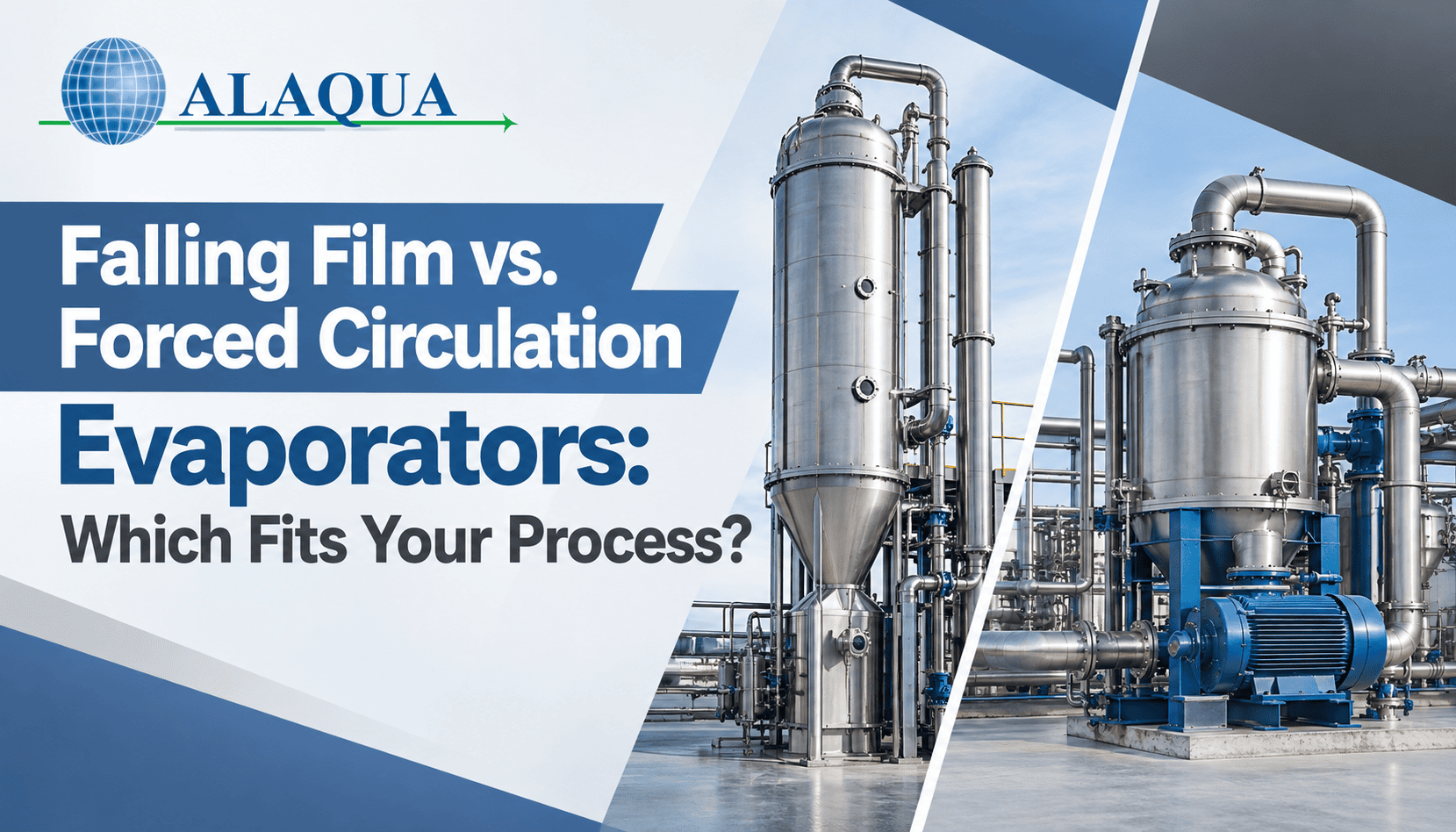
If you’re comparing evaporator systems for a new project, you’ve probably run into the same question over and over – falling film vs forced circulation evaporator. Which one actually fits your process? Both types remove water or solvent from a liquid feed, but the way they do it, and the situations where each one actually performs well, are pretty different. Picking the wrong one can mean higher energy bills, more downtime for cleaning, or a product that doesn’t come out the way it should. Here’s how the two compare, so you can figure out which one fits your process.
How a Falling Film Evaporator Works
Picture a bundle of vertical tubes. Liquid feed goes in at the top and runs down the inside wall of each tube as a thin film, pulled by gravity alone. Steam heats the outside of the tubes, and as the liquid trickles down, it starts to vaporize, with the vapor rising up through the middle of the tube.
Because the liquid is only on the heated surface for a short time, this design doesn’t cook the product much. That’s a big reason dairy plants, juice producers, and food manufacturers lean toward falling film evaporators. Flavor, color, and nutrients hold up better when heat exposure is minimal. There’s also an efficiency angle here: a thin film transfers heat quickly, so falling film units can get the job done without needing a huge temperature difference between the steam and the product.
How a Forced Circulation Evaporator Works
Forced circulation skips the gravity-only approach. A pump pushes the liquid through a heat exchanger and back into a separation vessel at high speed, over and over. Keeping the liquid moving matters here, because if it sat still against a hot surface, it would start scaling or crystallizing fast.
That’s exactly why this type gets picked for tougher liquids: things like brines, caustic solutions, and process streams that are thick, dirty, or prone to forming crystals as they concentrate. You do pay for that toughness, though. The pump adds upfront cost and burns more energy day to day than a gravity-fed falling film setup would.
Key Differences at a Glance
So how does this evaporator type comparison shake out in practice?
- Fouling resistance: Forced circulation wins here. The constant pumped flow keeps scale and crystals from building up on the heat transfer surfaces.
- Heat sensitivity: Falling film is the better pick for anything temperature-sensitive: dairy, food concentrates, and pharmaceuticals.
- Viscosity: Forced circulation can handle thicker liquids. Falling film needs a feed that’s thin enough to form an even film on the tube wall.
- Energy use: Falling film usually costs less to run per gallon of water removed, since there’s no pump running around the clock.
- Maintenance: Forced circulation has more parts that can wear out or need attention, mainly the pump itself.
Neither one is the “correct” answer across the board. It really comes down to what you’re processing and how it behaves as it concentrates.
Matching the Technology to Your Process
Got a clean, lower-viscosity liquid where product quality is the main concern? Falling film is probably your best bet, and it’s why the technology is so common in dairy and beverage processing.
Dealing with something that scales easily, carries suspended solids, or needs to be pushed close to its saturation point? Forced circulation is the safer route. It’s designed to keep running even as the liquid thickens or starts throwing off crystals, which comes up constantly in chemical processing, brine concentration, and wastewater treatment.
Some plants don’t pick just one. In a multi-effect setup, it’s common to run falling film early on when the liquid is still thin, then switch to forced circulation as things concentrate and fouling becomes more of a risk. You get the energy savings of falling film up front and the durability of forced circulation where it’s actually needed.
Where These Evaporators Are Used
Both evaporator types show up across a wide range of industries, not just one niche application. Falling film systems are common in dairy processing, handling products like milk, whey, and yogurt where preserving quality matters most. They also show up in juice concentration and other heat-sensitive food applications.
Forced circulation systems tend to show up wherever fouling or crystallization is a real risk. That includes caustic soda processing, wastewater treatment, and applications involving salts and other crystallizing solutions. Some plants also use forced circulation as part of a zero-liquid-discharge (ZLD) setup, where the goal is to recover as much usable water as possible from a waste stream.
Knowing which category your application falls into is often the fastest way to narrow down which evaporator type makes sense before getting into finer details like footprint or turndown.
Other Factors Worth Considering
A few things beyond the basic mechanics are worth thinking through too:
- Footprint: Falling film units tend to run tall because of the vertical tube layout. Forced circulation can sometimes be built into a smaller footprint, depending on the layout.
- Turndown: If your feed rate swings a lot, forced circulation usually handles that better, since the pump controls circulation independent of the natural flow.
- Cost over time: Falling film tends to be cheaper to operate day-to-day. Forced circulation costs more to run but can mean fewer cleaning cycles and less unplanned downtime with fouling-prone liquids.
None of this replaces actually looking at your feed, your target concentration, and what you’re trying to accomplish. There’s no one-size-fits-all answer here.
Getting the Right Evaporator System for Your Application
This decision affects your energy costs, your product quality, and how much time your team spends on maintenance for years down the line. It’s worth working with a manufacturer who’ll actually look at your feed properties and production goals instead of pushing a standard setup.
Alaqua Inc. builds both falling film and forced circulation evaporator systems, with over 25 years of experience supplying food-grade, sanitary, ASME code evaporators. Whether you need gentle handling for a heat-sensitive product or something rugged enough for fouling and crystallizing liquids, there’s a configuration that fits.
Request a quote to talk through which evaporator technology makes sense for your process.