Industrial facilities are under growing pressure to cut wastewater discharge costs while meeting stricter environmental regulations. For plants generating high-strength brine or process wastewater, a crystallizer wastewater treatment system can turn what used to be a disposal expense into a recovery asset – reclaiming water for reuse and converting dissolved salts into a saleable or safely disposable solid. Understanding how this equipment pays for itself is essential before committing capital to a project.
ALAQUA Inc. is a US-based original equipment manufacturer with more than 25 years of experience designing and supplying thermal process equipment – including evaporators, distillation systems, and crystallizers – to the chemical, environmental, food, pharmaceutical, and power generation industries. Every system is built to ASME and CE standards, and ALAQUA provides single-source responsibility from initial consultation through installation, start-up, and commissioning.
What a Crystallizer Does in a Wastewater System
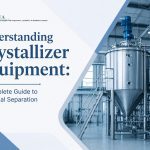
A crystallizer concentrates liquid waste streams into solid crystals and clean water, using a solid-liquid separation technique. Crystallization happens in two stages: primary nucleation, where new crystals begin to form, and secondary nucleation, the stage responsible for the bulk of crystal mass production. In a wastewater application, crystallizers are typically paired with an evaporator: the evaporator concentrates the wastewater first, boiling off water to shrink the volume of liquid, and the crystallizer then takes that concentrated brine and drives it the rest of the way to dry or semi-dry solids.
This combination is central to achieving zero liquid discharge (ZLD), a design goal where no liquid effluent leaves the facility at all. A typical brine concentrator ahead of the crystallizer can recover 95 to 99% of the wastewater as clean, reusable distillate, while the crystallizer handles the remaining concentrated stream.
Industrial Crystallizer Applications That Drive ROI
Crystallizers are used across a wide range of process streams, and ALAQUA’s project experience spans applications including wastewater, RO-concentrate minimization, desalination, caustic soda, sodium and potassium salts, sulfates, and other high-salinity effluents. The return on investment in each of these cases tends to come from three places:
- Water recovery: Reclaiming 95%+ of a wastewater stream reduces the volume of fresh water a plant needs to purchase and the volume of effluent it has to pay to dispose of or discharge.
- Salt recovery: Depending on the stream chemistry, the solid crystals produced sodium chloride, sodium sulfate, potassium salts, and others that can sometimes be sold or reused on-site rather than trucked to a landfill or disposal site as waste.
- Regulatory compliance: Facilities facing tightening discharge permits or ZLD mandates avoid the compounding cost of fines, permit renegotiation, or forced shutdowns by treating the problem at the source.
Matching Crystallizer Type to Application
The type of crystallizer selected has a direct effect on operating cost and crystal quality, which in turn affects ROI:
| Forced Circulation Crystallizer | Operates from low vacuum to atmospheric pressure; suited to applications where exact crystal size isn’t critical. Handles scaling-prone streams such as CaSO₄-saturated solutions, demineralization effluents, and vinegars. |
| Oslo Type (Classified-Suspension) Crystallizer | Produces large, coarse crystals with lower fines generation. Because crystals aren’t in contact with an agitation device, energy requirements and maintenance costs are lower – a meaningful factor in long-run ROI. |
| Cooling Crystallizers | Lower the temperature of a concentrated solution to force out dissolved solids; effective for materials whose solubility changes sharply with temperature. |
| Evaporative Crystallizers | Concentrate a solution by boiling off solvent until crystals form; commonly paired with cooling units in ZLD wastewater systems. |
| Vacuum Crystallizers | Combine temperature and pressure control, useful for temperature-sensitive process streams. |
ALAQUA has the engineering expertise to work across all of these configurations with total or partial classification, with or without magma recirculation, and with or without settling zones, so the equipment is matched to the chemistry rather than the chemistry being forced to fit standard equipment.
Calculating the ROI Case
When a plant evaluates a crystallizer project, the payback calculation generally weighs the capital and operating cost of the system against three savings categories: avoided wastewater hauling and disposal fees, avoided fresh water purchase costs from recovered distillate, and any revenue or avoided-cost value from the recovered salt. Facilities dealing with high-volume, high-salinity streams – where hauling costs are already significant – tend to see the fastest payback, since every gallon converted to reusable distillate is a gallon that no longer needs to be trucked offsite.
Operating cost also matters as much as upfront capital. A crystallizer with lower energy demand, less fines destruction, and longer cycles between washing – such as an Oslo-type unit – can carry a better lifetime ROI than a cheaper system with higher day-to-day operating costs, even if its initial price tag is higher.
Partnering on a Wastewater Crystallizer Project
Because ROI depends on getting the crystallizer type, materials of construction, and integration with upstream evaporation right, working with a single vendor across the full project reduces risk. ALAQUA supports the entire lifecycle: basic and detailed engineering, fabrication to ASME requirements, installation and commissioning, operator training, and retrofitting of existing systems. Learn more about the full range of crystallizer configurations ALAQUA supplies.
Conclusion
A well-matched crystallizer wastewater treatment system turns a compliance cost into a recovery investment, reclaiming water, recovering salts, and protecting a facility from tightening discharge regulations. With over 25 years of experience engineering thermal process equipment for demanding industrial applications, ALAQUA can help evaluate the right crystallizer configuration for your wastewater stream and build the ROI case for your project. Request a quote today to get started.