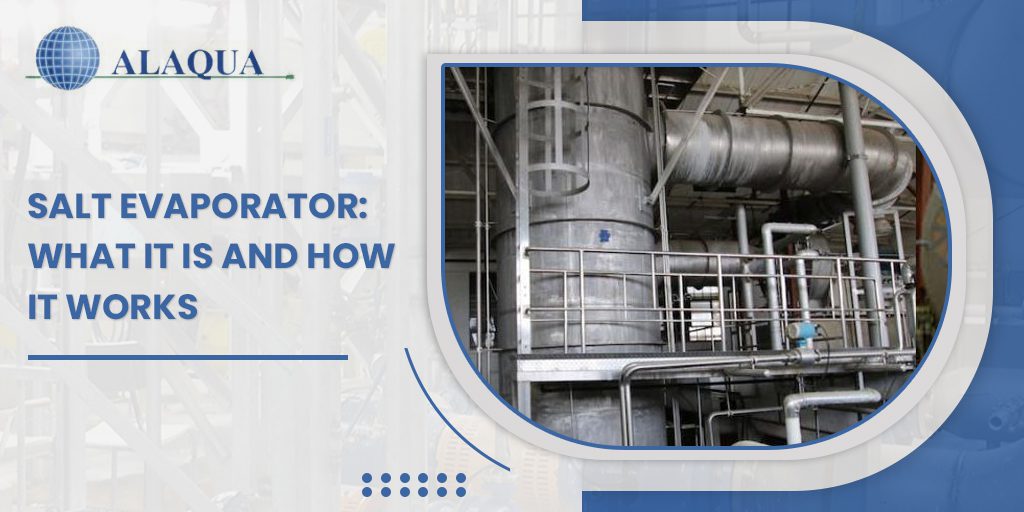
Salt production, industrial wastewater treatment, and chemical manufacturing all deal with the same fundamental challenge: a liquid solution that contains dissolved salt and a need to get that salt out in a usable, concentrated, or solid form. The equipment that handles this is a salt evaporator, and across these industries, getting it right determines product quality, operating costs, and environmental compliance all at once.
This post covers what a salt evaporator actually is, how it works, where it gets used, and what Alaqua Inc. brings to facilities that need this type of equipment.
What Is a Salt Evaporator?
A salt evaporator is industrial equipment that removes water or other solvents from a salt-containing solution by applying heat, reducing the liquid phase, and concentrating or recovering the dissolved salt. The end goal depends on the application. In salt manufacturing, it’s producing a clean crystalline product; in wastewater treatment, it’s reducing brine volume or achieving zero liquid discharge (ZLD); in chemical processing, it’s concentrating or purifying a sodium or potassium salt stream.
Salt evaporators don’t come in one design. Several configurations exist, and which one fits a given project depends on the specific salt being processed, how concentrated the feed is, what form the end product needs to take, and what happens downstream.
How a Salt Evaporator Works
The basic principle holds across all configurations – heat goes into a salt-bearing solution, water comes out as vapor, and what stays behind gets more concentrated until salt crystals form.
- Feed enters the system: Brine, wastewater, or process solution comes in at a set temperature and concentration. What’s in that feed matters a lot. Natural brines don’t just carry the target salt. They typically bring calcium sulfate, magnesium chloride, magnesium sulfate, and other compounds along with them. These impurities change how the equipment corrodes and how pure the crystals come out, which is why the feed gets analyzed thoroughly before anything gets specified.
- Heat goes in: Steam heats the process liquid through the heat exchanger surfaces. The solution starts boiling at a temperature that depends on its concentration and the pressure at which the system is running. Running under vacuum drops the boiling point, which means less energy input and makes it possible to process heat-sensitive materials without breaking them down.
- Vapor comes out: Water vapor leaves the liquid and goes to a condenser. In multiple-effect setups, that vapor becomes the heating source for the next stage. stacking energy reuse across sectors. MVR systems take the vapor a step further: it gets compressed, its temperature rises, and it cycles back as the heating medium for the same effect. That loop cuts external steam consumption significantly.
- Salt concentrates and crystallizes: As water leaves, the solution gets more concentrated. Past a certain point, it becomes supersaturated, and salt crystals start forming. The slurry of crystals and mother liquor moves to solid-liquid separation equipment, centrifuges, or filters to isolate the salt product.
- Corrosion and materials selection: Salt evaporators face some of the most aggressive material challenges in process equipment. Chloride environments at elevated temperatures attack standard stainless steel. Calcium sulfate and other impurities scale on heat transfer surfaces. Getting the materials specification right, the right alloy for tubes, body, and heat exchanger surfaces, determines how long equipment lasts and how often it needs cleaning.
The Alaqua blog on the importance of evaporator raw material selection in salt making goes into detail on this specific challenge.
Where Salt Evaporators Get Used
-
- Solar and vacuum salt production: Vacuum salt plants use evaporators to concentrate brine and produce food-grade and industrial salt. The evaporator configuration, crystal size control, and washing cycles all affect the purity and particle size of the finished product.
- Chemical processing: Sodium chloride, sodium sulfate, potassium chloride, and other industrial salts are produced or recovered using evaporators throughout the chemical industry. Alaqua’s project history includes a 5,000 T/day NaCl system for PennSalt, a 1,000 T/day system for Hooker Chemical, and a 600 T/day system for PPG.
- Wastewater treatment and ZLD: Industrial facilities that cannot discharge concentrated brine to waterways use salt evaporators as part of ZLD systems. The evaporator concentrates the brine stream to the point where a downstream crystallizer can take it to dry solids, eliminating liquid discharge entirely.
- Desalination: Seawater and brackish water desalination plants produce large brine concentrate streams as a byproduct. Evaporators handle the concentration of these streams in facilities pursuing minimal liquid discharge.
- Food and pharma: Purified salts used in food processing and pharmaceutical manufacturing are produced using evaporation and crystallization systems built to sanitary standards.
Alaqua Inc’s Salt Evaporator Services
- Alaqua Inc has designed and supplied salt evaporators for some of the largest salt production and chemical processing installations in North America, with individual systems ranging from hundreds to thousands of tons per day.
Equipment configurations supplied for salt applications include:
- Forced Circulation Evaporators: The primary workhorse for salt crystallization. High-velocity circulation prevents boiling on heat transfer surfaces, which is where scaling starts. Appropriate for NaCl, Na₂SO₄, KCl, ammonium sulfate, and many other salts.
- MVR (Mechanical Vapor Recompression) Evaporators: Compress evaporated vapor and use it as the heating medium rather than consuming fresh steam. Significant reduction in energy cost per ton of water evaporated, important at the scale of salt production.
- Multiple-Effect Evaporators: Each effect uses vapor from the previous stage as a heating medium. Reduces steam consumption proportional to the number of effects, at the cost of higher capital investment.
- Evaporative Crystallizers: Combined evaporation and crystallization in one unit, where product crystal size and purity are the primary design targets. More on crystallizer options is covered in the crystallizer systems section.
Alaqua handles the full project lifecycle, from consultation, engineering, fabrication to ASME and CE standards, installation supervision, and commissioning. Single-source responsibility means one team manages the process from specification through startup. Service capabilities also include solvent recovery systems, heat exchangers, and related process equipment for facilities sourcing an integrated system.
Conclusion
A salt evaporator is the core piece of equipment in any process that needs to recover, purify, or dispose of dissolved salt on an industrial scale. Getting the materials specification, heat transfer configuration, and energy recovery design right determines operating cost, maintenance frequency, and product quality for the life of the system.
Alaqua Inc brings decades of documented salt evaporator experience from table salt crystallizers to multi-thousand-ton-per-day NaCl systems to facilities worldwide. Reach out to discuss your application.
Phone: +1 551-482-7568
Email: info@alaquainc.com
FAQs
Q1. What is the difference between a salt evaporator and a salt crystallizer?
Ans: A salt evaporator removes water from a brine solution to concentrate it. A crystallizer takes that concentrated solution further, to the point where salt crystals form and can be separated. In many systems, evaporation and crystallization are combined in sequence or in a single unit. The terms overlap in practice, particularly in evaporative crystallizer configurations where both functions happen simultaneously.
Q2. Why is materials selection so critical in a salt evaporator?
Ans: Salt solutions, especially at elevated temperatures, are highly corrosive to standard stainless steel. Calcium sulfate and other impurities in natural brine scale on heat transfer surfaces if the design doesn’t account for them. Selecting the wrong alloy or tube material leads to premature failure and frequent cleaning shutdowns. Alaqua assesses feed composition before specifying materials for each installation.
Q3. What is MVR, and why does it matter for salt evaporation?
Ans: Mechanical Vapor Recompression (MVR) takes the steam generated by evaporation, compresses it to a higher temperature, and uses it as the heating medium for the same evaporator effect, dramatically reducing external steam consumption. At the scale of salt production, where energy is the dominant operating cost, MVR can cut energy use by 70% or more compared to a single-effect steam-fed system.
Q4. Can a salt evaporator be used in zero liquid discharge (ZLD) systems?
Ans: Yes, salt evaporators are a core component of ZLD systems. The evaporator concentrates the brine stream; a downstream crystallizer takes the concentrate to dry solids. Together, they allow industrial facilities to eliminate liquid brine discharge while potentially recovering a saleable salt product.
Q5. What project scale does Alaqua Inc handle for salt evaporation?
Ans: Alaqua’s documented experience ranges from smaller industrial installations to multi-thousand-ton-per-day NaCl systems. Past projects include a 5,000 T/day NaCl system for PennSalt, a 1,000 T/day NaCl system for Hooker Chemical, and a 600 T/day system for PPG, among others.