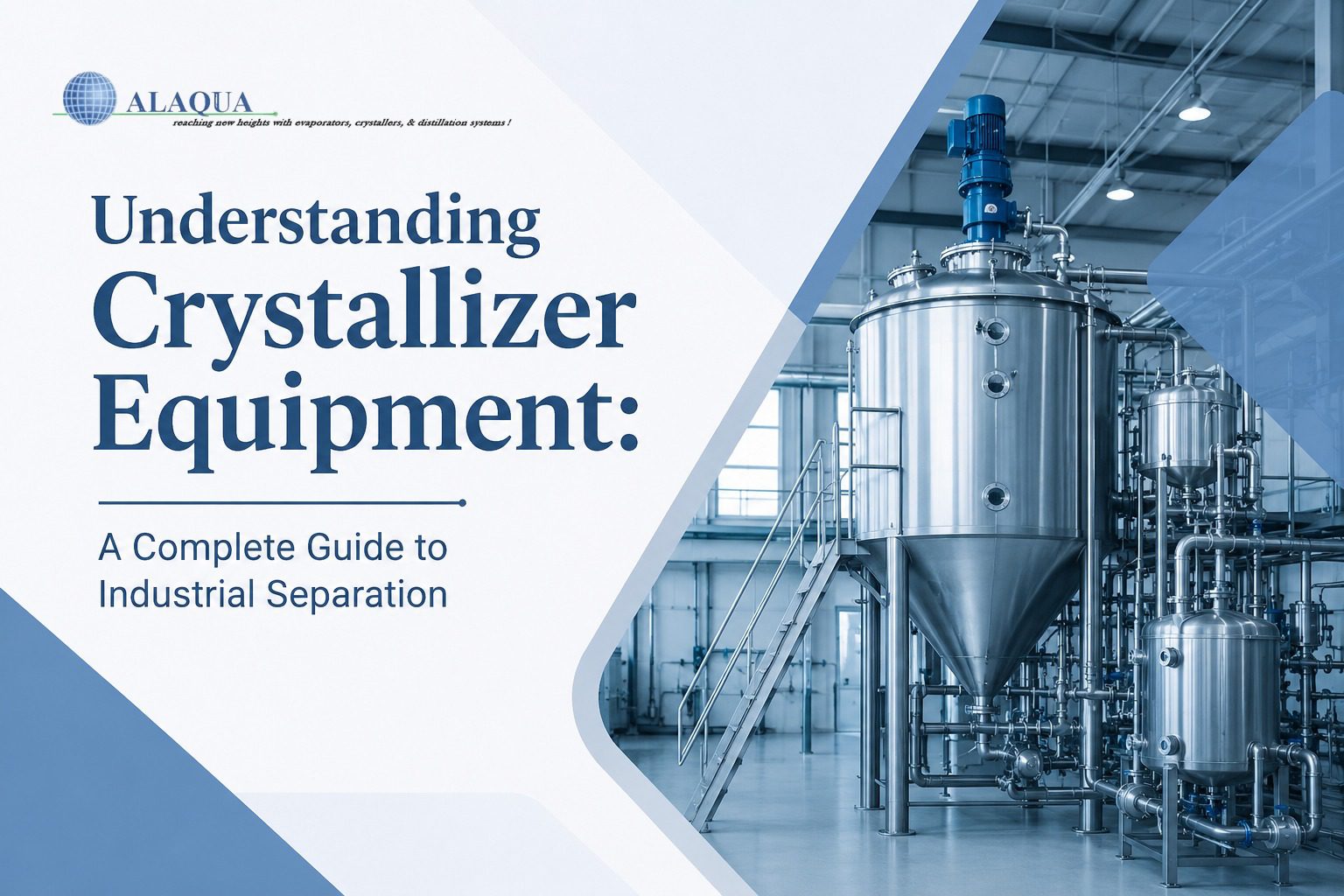
A crystallizer is a critical piece of industrial equipment used to concentrate liquid solutions into solid crystals and clean water. This solid-liquid separation technique is essential across numerous manufacturing sectors, ensuring the efficient recovery of valuable solids while managing liquid waste. As industries increasingly focus on sustainability and zero liquid discharge (ZLD), the demand for high-performance crystallization equipment grows.
Alaquai Inc. is a premier US corporation and original equipment manufacturer (OEM) specializing in high-quality process equipment. Established in 1989, the company brings over 25 years of experience in designing and supplying thermal process solutions, including evaporator systems, distillation plants, and advanced crystallizers. Serving diverse sectors such as chemical processing, environmental management, food and beverage, dairy, pharmaceuticals, and power generation, the company delivers equipment built to stringent ASME and CE standards. Alaquai Inc. offers single-source responsibility from initial consultation through installation.
The company also serves clients in locations like Windermere and beyond, ensuring global reach and localized expertise.
Need expert guidance for your processing application? Get a free consultation/get a quote by calling +1 551-482-7568 or emailing info@alaquainc.com.
The Science of Crystallization
The crystallization process is fundamentally divided into two primary stages: primary nucleation and secondary nucleation. Primary nucleation involves the initial formation of new crystals from a supersaturated solution. Secondary nucleation occurs when existing crystals break apart or interact, leading to the mass production of smaller crystals. Mastering these stages is crucial for controlling crystal size, purity, and overall yield.
To achieve optimal results, facilities must select the appropriate crystallizer equipment based on specific application requirements. A salt crystallizer processes brine to yield solid salt crystals and reusable water, making it highly effective for wastewater treatment and meeting stringent environmental regulations, including Zero Liquid Discharge (ZLD) mandates.
Types of Crystallization Equipment
Selecting the correct equipment depends heavily on the chemical properties of the solution and the desired crystal characteristics. Alaquai Inc. possesses the expertise for all types of crystallization equipment, including options with total or partial classification.
| Equipment Type | Key Characteristics and Applications |
| Forced Circulation Crystallizer | Operates from low vacuum to atmospheric pressure. Ideal when crystal size is not of the utmost importance or when crystals grow at a fair rate. Commonly used for NaCl, KNO₃, and Na₂SO₄. |
| Oslo Type (Classified-Suspension) | Designed for the production of large, coarse crystals. Features a classifying crystallization chamber and a liquor-vapor separation area. Highly energy-efficient, as crystals do not contact agitation devices. |
| Cooling Crystallizers | Lowers the temperature of a concentrated solution to force dissolved material out as solid crystals. Best suited for materials whose solubility changes significantly with temperature. |
| Evaporative Crystallizers | Removes solvent by boiling to concentrate the solution until crystals form. Often paired with cooling units in ZLD systems. |
| Vacuum Crystallizers | Utilizes combined temperature and pressure control to induce crystallization, particularly useful for sensitive materials. |
These systems can stand alone or be combined with other technologies, such as evaporators. Steam-driven evaporators remove water from a solution, concentrating the product by boiling the solvent. A typical brine concentrator can recover 95 to 99 percent of wastewater for reuse. For a deeper dive into specific technologies, readers can explore our detailed guide on Cooling Crystallizers: What It Is and How It Works.
Industrial Applications and ZLD
Crystallization equipment is deployed across a wide array of industries. In chemical processing, inorganic salts are routinely processed. The pharmaceutical manufacturing sector relies on cooling crystallization to isolate active pharmaceutical ingredients (APIs), providing tight control over purity and particle size.
In the food and beverage industry, crystallizers are utilized for sugar refining. One of the most demanding applications is in industrial wastewater treatment and zero liquid discharge (ZLD) systems. In a ZLD configuration, the crystallizer takes a concentrated brine stream from an evaporator and converts it into dry or semi-dry solids, eliminating liquid discharge while recovering salts.
For more information on how these systems integrate with other thermal processes, check out our article on Why Getting Your Evaporator System Right Matters More Than You Think.
Partnering for Success
Implementing advanced process equipment requires a partner with deep engineering expertise. Alaquai Inc. designs and supplies cooling crystallizers and other thermal systems for clients worldwide. From basic engineering to fabrication under ASME standards, operator training, and commissioning, Alaquai Inc. provides a unified team, eliminating the friction of coordinating between multiple vendors.
Whether you are upgrading an existing facility or designing a new plant, choosing the right crystallization equipment is a critical investment in long-term operational success.
Frequently Asked Questions (FAQs)
1. What is the primary function of a crystallizer in an industrial setting?
A crystallizer concentrates liquid solutions into solid crystals and clean water. It is a solid-liquid separation technique that helps industries recover valuable solids and manage liquid waste, often playing a crucial role in Zero Liquid Discharge (ZLD) systems.
2. How does a cooling crystallizer differ from an evaporative crystallizer?
A cooling crystallizer lowers the temperature of a concentrated solution to trigger crystallization, ideal for materials whose solubility is highly temperature-dependent. An evaporative crystallizer removes solvent by boiling the solution to concentrate it until crystals form.
3. What industries commonly use crystallization equipment?
Crystallization equipment is widely used in chemical processing, pharmaceutical manufacturing, food production, mining, and industrial wastewater treatment.
4. What is a Zero Liquid Discharge (ZLD) system, and how do crystallizers fit into it?
A ZLD system maximizes water recovery and minimizes wastewater discharge. In a ZLD system, evaporators concentrate the wastewater, and crystallizers take the final step by converting the concentrated brine into dry or semi-dry solids, ensuring no liquid waste leaves the facility.
5. What services does Alaquai Inc. provide for crystallizer projects?
Alaquai Inc. offers comprehensive services, including initial consultation, basic engineering, equipment fabrication to ASME standards, installation supervision, personnel training, and full commissioning.
Conclusion
Selecting the right crystallizer equipment is essential for achieving optimal product quality and operational efficiency. With over 25 years of experience, Alaquai Inc. provides the engineering expertise necessary to meet your industrial processing needs. For a free consultation or to get a quote, please contact us at +1 551-482-7568 or email info@alaquainc.com.