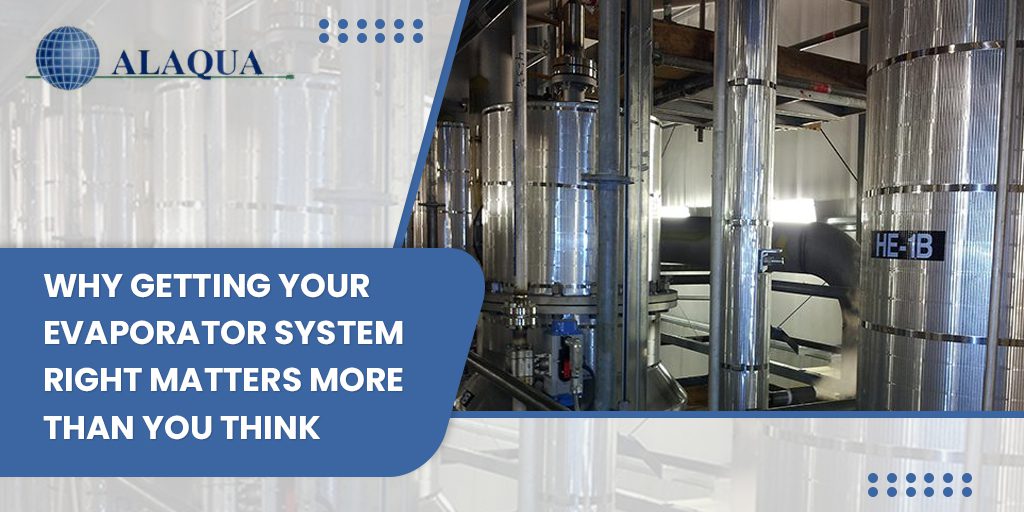
If you’ve spent any time around industrial machinery, you already know that a good evaporator system does far more for your business than most people realize. Most folks just see a big, expensive piece of stainless steel, but when you’re on the floor, dealing with production quotas and rising utility bills, you quickly realize these systems are the heart of the plant. If the heart isn’t beating right, everything else fails. At Alaqua Inc., we’ve seen it all: the good, the bad, and the situations where you wonder how it was ever allowed to run.
The Reality of the “Kettle” Myth
One of the biggest misconceptions you might have heard is that an evaporator is just a fancy kettle that heats things up until the water goes away. If only it were that simple.
In the real world, you’re dealing with temperamental liquids. Some get thick like molasses the second you start concentrating them. Others carry minerals that stick to the inside of your tubes and turn into rock-hard scale that’s a nightmare to clean.
If you’re processing something like milk or a delicate chemical, you can’t just blast it with heat; you’ll scorch it. You’ve got to be smart. That’s why falling film designs are so important. The liquid slides down the tubes in a thin layer, evaporating almost instantly. Fast, gentle, and quality-preserving. But getting that film to distribute perfectly across hundreds of tubes? That’s where the real engineering comes in.
When Things Get Messy: Forced Circulation
If your process involves slurries, high-viscosity liquids, or materials that love to foul equipment, you need a different approach: forced circulation evaporators.
Instead of relying on gravity, a massive pump shoves the liquid through the heat exchanger at high speeds. The goal? Don’t let it sit still long enough to cause trouble. By keeping velocity high, you prevent boiling right on the tube surface, which is exactly where scaling starts.
This is the workhorse for wastewater treatment. Many plants are ready to give up on their waste streams because they can’t concentrate them without the evaporator clogging every two days. A properly designed forced circulation setup can change everything.
The Part Nobody Talks About: Crystallization
Concentrating a liquid is one thing, but what if you need the actual solids? Or what if your waste stream is so full of salt or chemicals that you simply can’t dump it? This is where crystallization comes in: part science, part art. You’re taking a solution and forcing it to grow crystals. Ash crystallizers in the pulp and paper industry. These plants deal with harsh “liquor” cycles loaded with chloride and potassium. If you don’t remove those elements, they’ll eat your recovery boilers from the inside out, a slow-moving disaster inside your pipes. An ash crystallizer pulls those corrosive elements out of the loop, saves your equipment, and helps you hit zero liquid discharge goals. Sustainable, and it doesn’t have to break the bank.
Why “Off-the-Shelf” Usually Fails
You’ve probably seen it happen: a company tries to save money by buying a standard, one-size-fits-all evaporator. Six months later, it’s not performing, or it’s leaking.
Here’s the truth – every application is different. Your liquid isn’t the same as the liquid at the plant down the road. You might have more silica, a different pH, or a specific organic compound that reacts badly to certain metals.
That’s why at Alaqua Inc., we don’t just sell equipment. We take single-source responsibility: design, fabrication, installation, all of it. Some projects require custom-engineered tube alloys because standard stainless steel wouldn’t last a month. Without that level of detail, you’re simply throwing money away.
The Money Talk: Efficiency and Recovery
Nobody buys an evaporator system just for looks; you buy it to save money or make money.
Energy is the highest cost in evaporation. If you’re venting steam into the atmosphere, you’re literally burning fuel for nothing. Modern systems use Mechanical Vapor Recompression (MVR), taking the vapor you created, compressing it to raise its temperature, and using it to heat the next batch. Incredibly efficient.
Then there’s product recovery. Many companies are dumping thousands of dollars worth of chemicals down the drain every day because they think it’s “waste.” An evaporator system lets you pull those chemicals back out and return them to the process, turning a liability into an asset.
Thinking Long-Term
Industrial equipment is a 20-year commitment. The choices you make today, the design, the supplier, and the maintenance plan will affect your operations for a long time.
It’s easy to get caught up in the initial price tag, but you need to look at the total cost of ownership. How much will it cost to run? How often will it need cleaning? How easy is it to get spare parts?
The industry is shifting toward closed-loop, sustainable systems, and for good reason. You can’t keep taking and dumping. Evaporators and crystallizers are the platforms that make responsible resource management possible. They’re the “green” technology that actually pays for itself.
Final Thoughts
You’ve got enough on your plate without worrying about a failing evaporator. Whether you’re scaling up production, meeting new environmental regulations, or just cutting your energy bills, we’ve likely seen a similar challenge before.
At Alaqua Inc., we’re a team of engineers and problem-solvers focused on your outcome – not a quick sale. We’re looking for a long-term partnership.
If you’ve got a liquid processing problem keeping you up at night, reach out to us.
Phone: +1 551-482-7568
Email: info@alaquainc.com
Let’s walk through the numbers, look at your specific process, and find a solution that works for you.