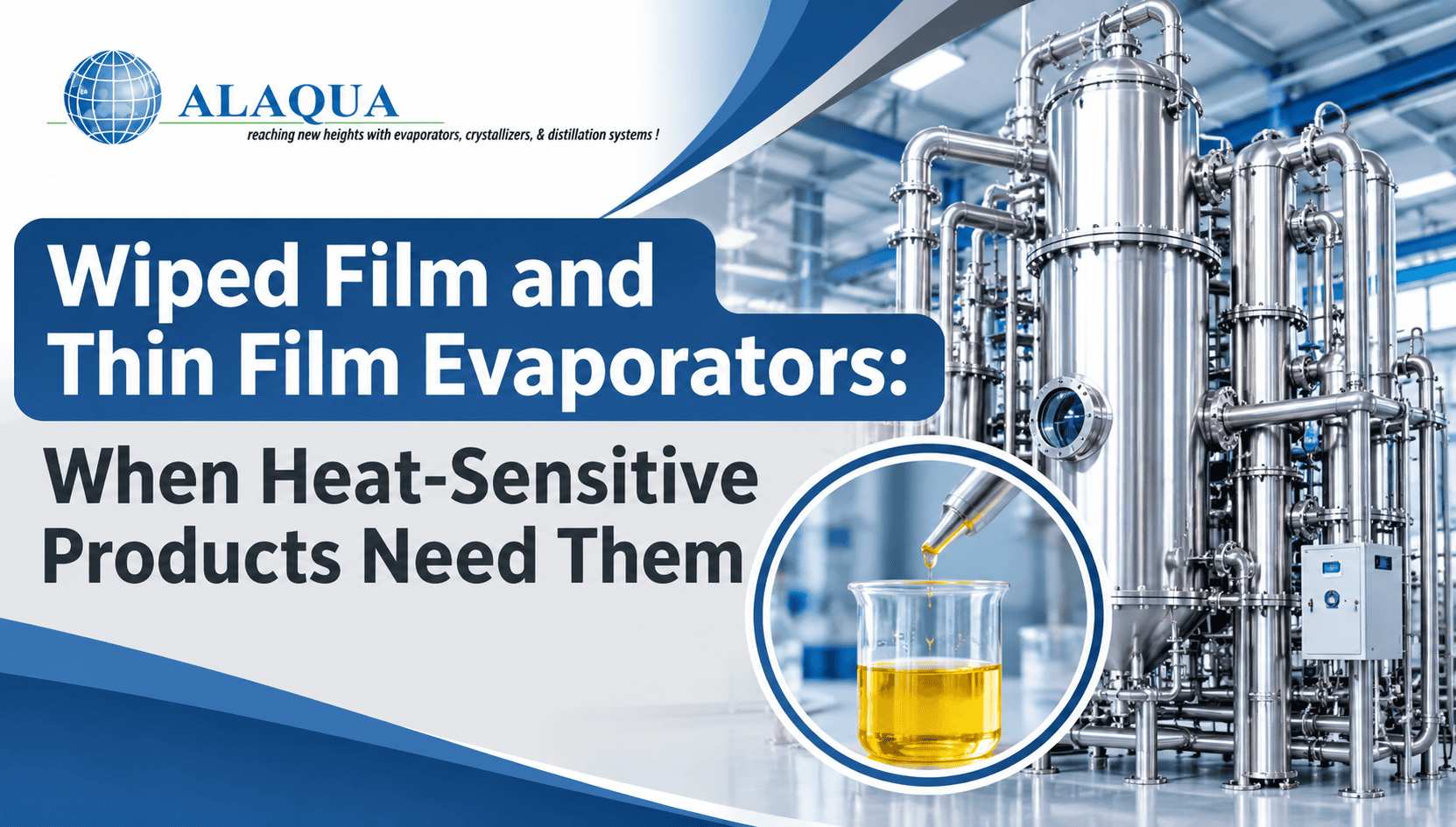
A wiped film evaporator for heat-sensitive products keeps boiling temperature as low as possible and time on the heating surface as short as possible. Alaqua designs wiped film and thin film evaporators, as well as falling film units that run at low temperature differences with contact times measured in seconds per pass. The right type depends on your product characteristics, capacity and site.
Wiped Film Evaporator for Heat-Sensitive Products: Why the Design Matters
Evaporation removes a liquid from a solution, suspension or emulsion by boiling off some of the liquid. It is a thermal concentration process, and it ends with a more concentrated liquid that is still pumpable.
In most cases, it is essential that the product suffers no thermal degradation during evaporation. That means temperature and time exposure have to be kept to a minimum. This requirement, along with the physical characteristics of the product, is the reason a large range of evaporator types exists. Alaqua’s technology is supported by several test and development facilities, where it is continually refined and applied to new products.
Which Evaporator Types Does Alaqua Design?
Alaqua lists wiped film evaporators and thin film evaporators among the common evaporator types it designs most frequently. The same list includes falling film, forced circulation, plate, skid-mounted, vacuum, and thermal and mechanical vapor recompression (TVR and MVR) systems.
When Alaqua designs an evaporation plant, product characteristics are one of the main requirements considered. These include heat sensitivity, viscosity and flow properties, foaming tendency, fouling and precipitation, and boiling behavior. For wiped film and thin film specifications, contact Alaqua’s engineers.
Falling Film and Compact Skid Options for Heat-Sensitive Products
Falling film evaporators can be operated with low temperature differences between the heating media and the boiling liquid. Their product contact times are short, typically measured in seconds per pass. Because of this, Alaqua describes the falling film evaporator as particularly suitable for heat-sensitive products, and it is today the most frequently used type of evaporator. If you are weighing it against another design, read Falling Film vs. Forced Circulation Evaporators: Which Fits Your Process? on the Alaqua blog.
Alaqua’s compact skid-mounted evaporators work on the falling film principle. They are ideal for heat-sensitive products, with up to 20,000 lbs/hr (about 9,000 kg/h) of water removal and boiling temperatures as low as 115°F (46°C). They are fully skid-mounted and pre-assembled, so site installation needs no extensive foundation work.
Wiped Film vs. Falling Film Evaporators: Technical Comparison
| Feature | Wiped film / thin film | Falling film | Compact skid-mounted falling film |
| Capacity | Contact Alaqua for specifications. | Designed carefully for each operating condition | Up to 20,000 lbs/hr (about 9,000 kg/h) of water removal |
| Product type | Contact Alaqua for specifications. | Heat-sensitive products | Heat-sensitive products in dairy, beverage, specialty food and industrial fluid applications |
| Energy use | Contact Alaqua for specifications. | Small temperature differences allow multiple effect or MVR configurations with low energy consumption. | Live steam or TVR, with some vapors recycled for efficiency |
| Maintenance | Contact Alaqua for specifications. | Needs sufficient wetting of the heating surface; otherwise, dry patches and scaling occur. Quick start-up and easy change to cleaning mode. | Low maintenance costs, stainless steel components, minimum moving parts, few gaskets, CIP provisions |
Thin Film Evaporator Applications and Related Uses
These examples come from Alaqua’s published list of evaporator and crystallizer applications:
- Dairy whey concentration: whey, milk and yogurt are all listed.
- Juice concentration: apple juice, citrus juice, grape juice and tomato juice.
- Coffee extract and herb extracts: listed among Alaqua’s applications.
- Gelatin and collagen: both appear on the same list.
- Sugar and sweetener syrups: glucose, fructose, dextrose and sucrose.
- Solvent separation and aroma recovery: also listed.
- Wastewater and ZLD: wastewater and zero-liquid-discharge applications are covered.
How to Choose an Evaporator: What to Check First
Before you compare equipment, collect the points Alaqua uses to design an evaporation plant:
- Capacity and operating data, including quantities, concentrations, temperatures and annual operating hours
- Product characteristics, such as heat sensitivity, viscosity, foaming, fouling and boiling behavior
- Operating media, such as steam, cooling water and electric power
- Capital, operating and personnel costs
- Materials of construction and surface finishes
- Site conditions, such as available space and energy connections
Personnel costs for operation and maintenance are part of this list, so upkeep deserves attention early. The Evaporator Maintenance Checklist for Plant Managers covers this in more detail.
Energy also matters. TVR generally has lower CAPEX but higher OPEX, while MVR has higher CAPEX but lower OPEX. The choice between them depends on local steam and electricity prices, possible use of hot condensate and depreciation of the capital cost.
Once you have these points ready, you can request a quote, and Alaqua will work out the equipment type and model that suits your process and location.
Thin Film Evaporator Manufacturer: What Alaqua Supplies
Alaqua is a US manufacturer of industrial evaporators, crystallizers, distillation systems and spray dryers. Equipment is supplied to ASME and CE requirements for the chemical, environmental, food, pharmaceutical and power generation industries. Alaqua can supply equipment for installation by the customer or skid-mounted and turnkey systems.
Alaqua offers single-source responsibility, which covers initial consultation, supply of equipment, and supervision of installation, start-up and commissioning. The company also trains your operators.
FAQ
Does Alaqua design wiped film and thin film evaporators?
Yes, both are listed among the evaporator types Alaqua designs most frequently.
Which evaporator type suits heat-sensitive products?
Falling film evaporators are particularly suitable because they run at low temperature differences with short contact times. For your product, the economics of your process and your location decide the equipment type and model best suited to your needs.
What are common thin film evaporator applications?
Alaqua’s published applications include dairy whey concentration, juice concentration, coffee and herb extracts, gelatin and collagen, sugar and sweetener syrups, solvent separation and aroma recovery, and wastewater and ZLD.
Does this equipment come with an ASME code?
Yes, Alaqua supplies equipment to ASME and CE requirements.
Do you supply skid-mounted or turnkey systems?
Yes, Alaqua supplies equipment for installation by the customer or skid-mounted and turnkey systems.
Need Help Choosing Between These Designs?
Have a heat-sensitive product and need help choosing between these designs? Talk to our process engineer to go through your requirements.