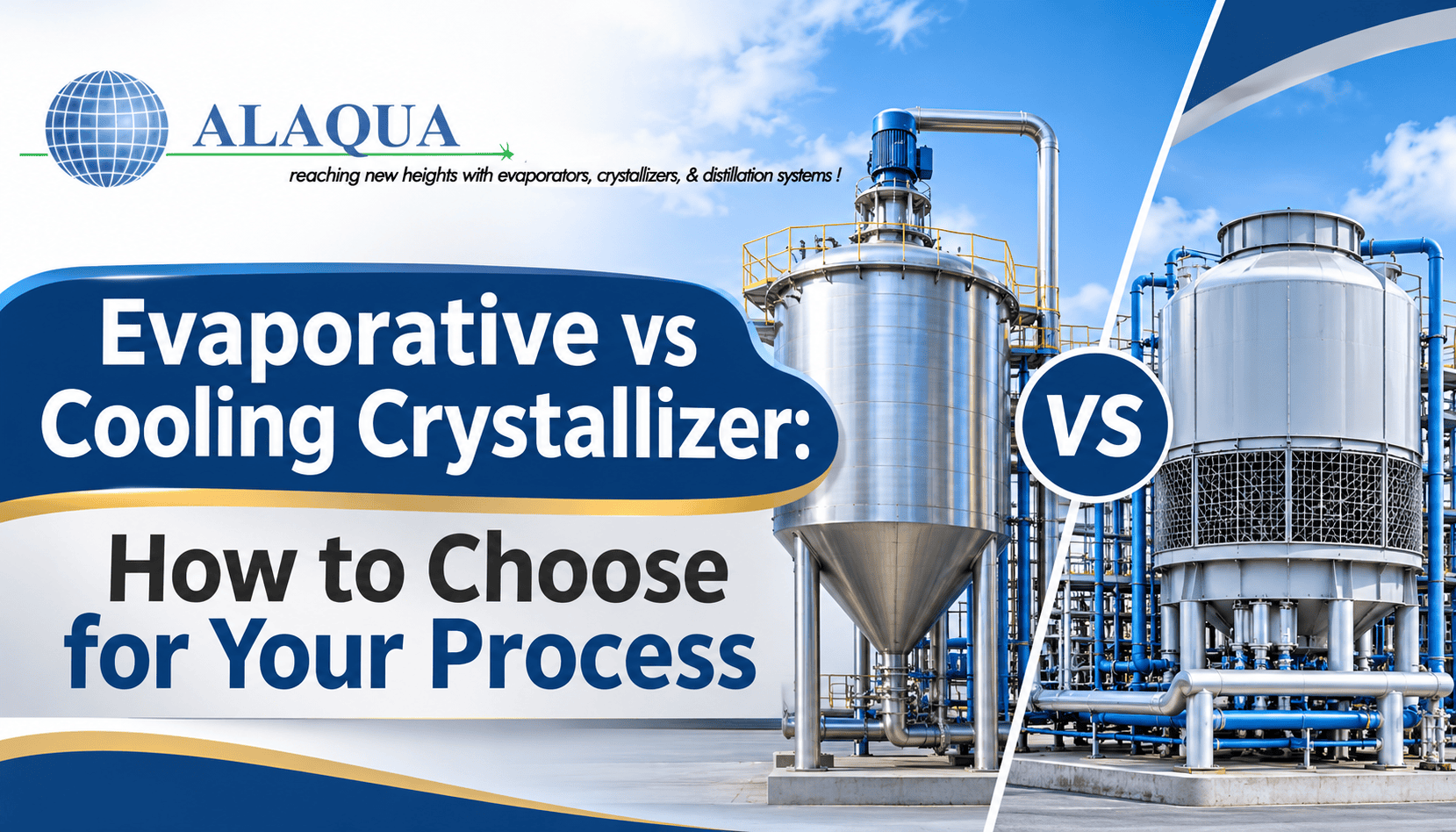
The main difference between an evaporative crystallizer and a cooling crystallizer is how each one creates supersaturation. An evaporative crystallizer removes solvent, usually water, to concentrate the solution. A cooling crystallizer lowers the temperature of the solution so the dissolved salt becomes less soluble and crystallizes out.
Which one fits your process depends on your feed, the crystal size you need, the risk of scaling, and whether you need zero liquid discharge (ZLD). Alaqua supplies both evaporative and cooling crystallizers, and the economics of your process and your plant location help decide the equipment type and model. This guide explains the difference and gives you a simple way to choose.
Evaporative Crystallizer vs. Cooling Crystallizer: The Basic Difference
Crystallization is a solid-liquid separation technique in which solid crystals form from a liquid solution. A crystallizer concentrates the feed into solid crystals and clean water. Crystallizers are used in manufacturing, chemical processing, mining, power stations, and many other applications, and they can eliminate liquid waste to create zero liquid discharge (ZLD).
The two routes to crystals work like this:
- Evaporative crystallization removes the solvent, generally water, so the solution becomes supersaturated. Steam-driven evaporators remove water from a solution by boiling the solvent.
- Cooling crystallization lowers the solution temperature so solubility drops and crystals form. A continuous cooling crystallizer (CCC) is used for other types of salts.
Crystallizers can stand alone or be combined with other technologies, such as evaporators. Selecting between the two routes requires an analysis of your application requirements.
As a general rule, cooling crystallization suits solutions where solubility falls strongly as temperature drops. When solubility changes little with temperature, removing solvent is usually the practical route. Your Alaqua engineer can confirm which applies to your solution.
How Crystallization Works
Whichever crystallizer you choose, the design has to manage three things for your product:
- Primary nucleation: new crystals form from a clear solution.
- Secondary nucleation: existing crystals trigger the formation of new ones, for example through contact or attrition. In most industrial crystallizers, secondary nucleation is the main source of crystal mass production.
- Crystal growth: existing crystals get larger as dissolved material deposits on them.
Balancing these steps is what controls crystal size and the number of fines.
Evaporative vs. Cooling Crystallizer at a Glance
| Forced circulation (evaporative) | Oslo-type (growth) | Continuous cooling (CCC) | |
|---|---|---|---|
| How supersaturation is created | Solvent removed by evaporation | Solvent removed in the upper liquor-vapor separation area | Solution cooled to reduce solubility |
| Best for | Crystal size not of the utmost importance, or crystals that grow at a fair rate | Large, coarse crystals | Other types of salts |
| Product examples | NaCl, KNO₃, sodium and potassium sulfate, NH₄Cl | Ammonium sulfate, sodium sulfate, silver nitrate, monoammonium phosphate | Other types of salts |
| Energy use | Single or multiple effects; vapor recompression, thermal or mechanical, is often applied | Lower operating costs when large, coarse crystals are required; fewer fines to destroy, so lower energy requirement | Sized to the cooling duty of your solution |
| Scaling and maintenance | A similar design is used where scaling impedes concentration, such as CaSO₄ saturated solutions | Long production cycles between washing periods | Reviewed for your specific salt and application |
Crystallizer Types Alaqua Offers
Alaqua lists five types of crystallizers: forced circulation, Oslo-type growth (classified as suspension), cooling, evaporative, and vacuum. The company states it has the know-how for all types of crystallization equipment, with total or partial classification, involving the recirculation of the magma, with or without settling zones.
Forced circulation crystallizers can be single- or multiple-effect, and the vapor recompression concept, thermal or mechanical, is often applied. They usually operate from low vacuum to atmospheric pressure. They are used when crystal size is not of the utmost importance or when the crystal grows at a fair rate. Almost any material of construction can be considered, depending on the application.
Oslo-type crystallizers are the oldest design developed for the production of large, coarse crystals. The lower part of the unit is the classifying crystallization chamber. The upper part is the liquor-vapor separation area, where supersaturation is developed by removing the solvent. Because the crystals are not in contact with any agitation device, fewer fines need to be destroyed, and the energy requirement is lower. If you need large, coarse crystals, an Oslo-type unit has lower operating costs than other types.
Where Each Type Is Used
These are product and industry examples from Alaqua’s crystallizer range:
- Salt recovery from brine: a salt crystallizer produces solid salt crystals and clean water.
- Sodium sulfate and potassium nitrate: forced circulation crystallizers, used when crystal size is not of the utmost importance or when crystals grow at a fair rate.
- Ammonium sulfate and monoammonium phosphate: Oslo-type crystallizers, the design developed for large, coarse crystals.
- Fertilizer-grade phosphoric acid and demineralization effluents: CaSO₄-saturated solutions where scaling impedes concentration.
- Industrial wastewater: a wastewater concentrator is a type of evaporator that turns waste-saturated industrial wastewater into distilled water for reuse. A typical brine concentrator can recover 95 to 99% of wastewater for reuse, and a crystallizer can recover salts that can then be used or sold, helping the plant meet ZLD requirements.
- Dairy whey and lactose processing: both are listed among Alaqua’s evaporator and crystallizer applications, along with citric acid, copper sulfate, boric acid, and RO-concentrate minimization.
Crystallizer Selection Guide: What to Check First
Start with these questions before you compare equipment:
- What is the feed, and do you need salt crystals, clean water, or both?
- Does crystal size matter?
- Will scaling be a problem in your solution?
- Do you need zero liquid discharge (ZLD)?
- What do your process economics and plant location allow?
Then use this table as a starting point:
| If you need | Consider |
|---|---|
| Large, coarse crystals | Oslo-type crystallizer |
| Crystal size is not critical, or crystals grow at a fair rate | Forced circulation crystallizer |
| A salt that suits cooling crystallization | Continuous cooling crystallizer (CCC) |
| ZLD or clean water recovery | Evaporator combined with a crystallizer |
| A scaling solution, such as CaSO₄ saturated feeds | A design that handles scaling; discuss with Alaqua |
Not sure which fits your process? Request a quote and Alaqua will help you choose.
Industrial Crystallizer Manufacturer: What Alaqua Supplies
Alaqua is a US manufacturer of industrial evaporators, crystallizers, distillation systems, and spray dryers. Equipment is supplied to ASME and CE requirements for the chemical, environmental, food, pharmaceutical, and power generation industries. Alaqua can supply equipment for installation by the customer, or skid-mounted and turnkey systems.
Alaqua offers single-source responsibility, which covers initial consultation, supply of equipment, and supervision of installation, start-up, and commissioning. Its services include basic engineering, detail engineering, fabrication of equipment, training of personnel, installation and commissioning, and retrofitting.
What to Have Ready When You Request a Quote
A short list of process details helps the team recommend the right crystallizer faster:
- Feed composition and the salt or product you want to recover
- Feed flow rate and temperature
- Target crystal size, if it matters for your product
- Any scaling concerns in your solution
- Whether you need ZLD or clean water for reuse
Frequently Asked Questions
What is the difference between evaporative and cooling crystallization?
Evaporative crystallization removes solvent, usually water, to concentrate the solution until crystals form. Cooling crystallization lowers the solution temperature so solubility drops and crystals form.
When should I use a cooling crystallizer?
A cooling crystallizer makes sense when the solubility of your salt falls strongly as temperature drops. Alaqua’s continuous cooling crystallizer (CCC) is used for other types of salts, and the team can confirm whether it suits your feed.
Which crystallizer gives large, coarse crystals?
The Oslo-type crystallizer, also called a classified-suspension crystallizer, was developed for large, coarse crystals.
Which type has lower operating costs?
When large, coarse crystals are required, an Oslo-type unit has lower operating costs than other types. Crystals are not in contact with any agitation device, so fewer fines need to be destroyed and the energy requirement is lower.
Can a crystallizer be combined with an evaporator?
Yes, crystallizers can stand alone or be combined with evaporators.
Can a crystallizer help with zero liquid discharge (ZLD)?
Yes. A brine concentrator can recover 95 to 99% of wastewater for reuse, and a crystallizer can recover salts that can then be used or sold, helping the plant meet ZLD requirements.
Does this equipment come with an ASME code?
Yes, Alaqua supplies equipment to ASME and CE requirements.
Do you supply turnkey systems?
Yes, Alaqua supplies equipment for installation by the customer, or skid-mounted and turnkey systems.
Choose the Right Crystallizer With Alaqua
The right crystallizer depends on your application, your product, and your process economics. Request a quote to talk through your feed and get a recommendation from a US crystallizer manufacturer.