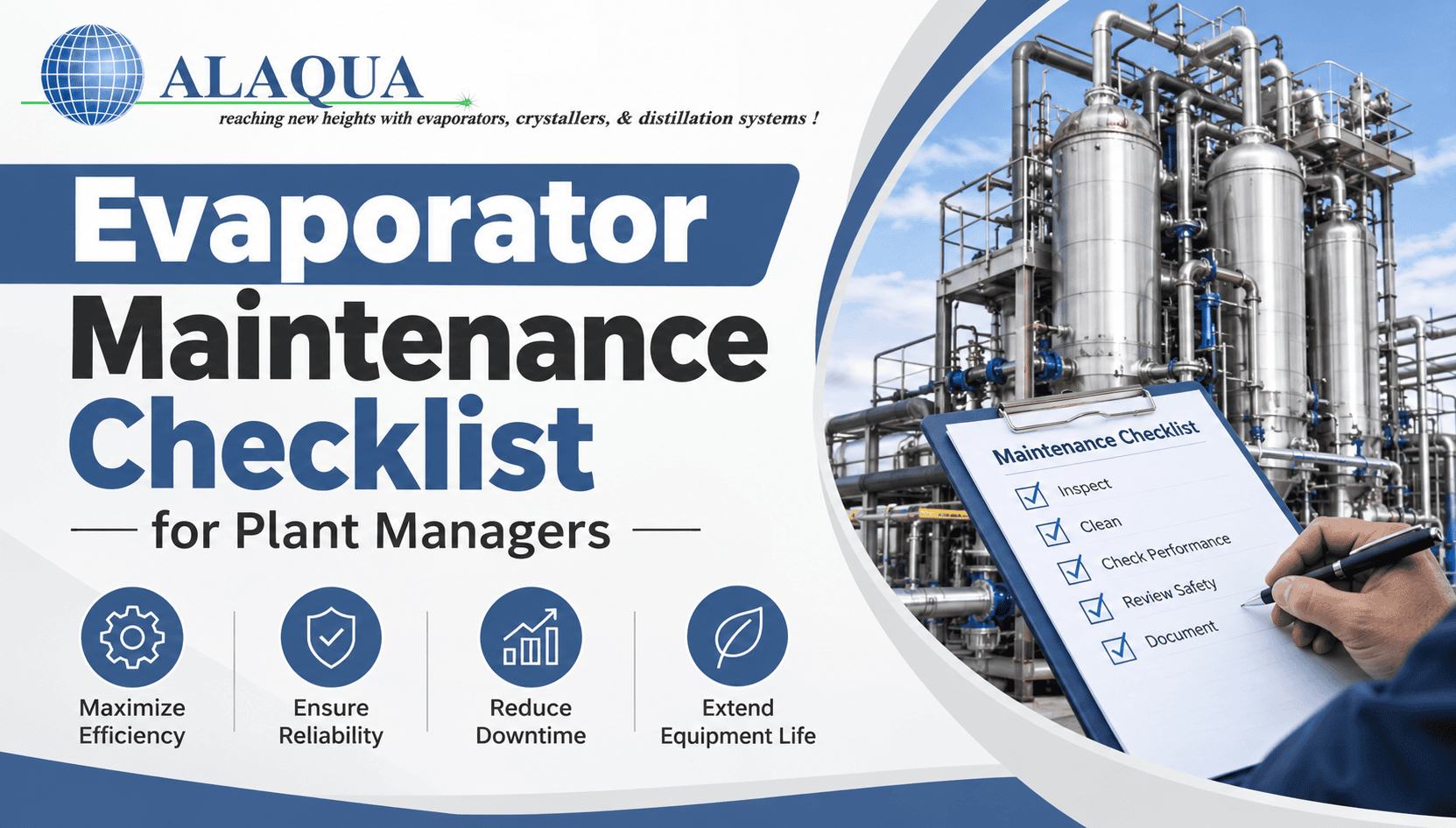
Alaqua lists personnel costs for operation and maintenance among the factors that shape an evaporator plant concept, next to capacity, product characteristics, operating media, and site conditions. That puts upkeep into the design conversation from the start. This evaporator maintenance checklist collects what Alaqua’s evaporator and service information says about the parts of a plant that need attention, so plant managers have one place to look.
The checklist follows the equipment, from the heating surface through to training and support. Which items apply depends on the type of evaporator you run, so start there.
Heating surfaces and wetting
In a falling film evaporator, the liquid enters at the top and is distributed evenly into the heating tubes, where a thin film flows downward at boiling temperature. Sufficient wetting of the heating surface is important for trouble-free operation. If the surfaces are not wetted sufficiently, dry patches and scaling occur and, at worst, the heating tubes clog. Wetting is therefore the first item on the evaporator maintenance checklist for a falling film unit.
Liquid distribution in the head
The design of the product distribution system in the head of the evaporator is critical for full and even wetting of the tubes. Alaqua’s evaporators use a static liquid distribution system that ensures all tubes in the calandrias receive equal amounts of liquid at all times and can accept wide variations in liquid flow and flash vapor. The distribution system belongs on the list next to the tubes.
Rising film (LTV) units
Rising film, long tube vertical evaporators work on the thermo-siphon principle. Feed enters the bottom of the heating tubes, and the product rises as a thin film. The upward movement creates a high degree of turbulence, which helps with viscous products and products that tend to foul the heating surfaces. These units usually need a high temperature difference between the heating and boiling sides. They are often run with product recirculation, so the temperature difference and the recirculation are the points to track.
Forced circulation units
Forced circulation evaporators are used when boiling on the heating surfaces has to be avoided because of fouling or to avoid crystallization on the heat transfer surface. The flow velocity in the tubes must be high, and high-capacity pumps are required. The liquid is heated only a few degrees on each pass, so a high recirculation flow rate is needed to keep heat transfer good. The circulation pumps, their motors, and the recirculation flow rate go on the list.
Plate evaporators
Plate evaporators use framed plates as the heating surface, with a product plate and a steam plate connected alternately. The plate package can be opened easily, so surfaces can be inspected, individual plates changed if necessary, and the evaporation rate altered by adding or removing plates.
Preheaters, separators, and condensers
External straight tube preheaters give short residence time, better deaeration of the calandrias, and easy inspection and cleaning. Liquid-vapor separation relies on controlled vapor velocities with tangential inlet and outlet, which keeps pressure losses to a minimum. Alaqua’s fabrication scope includes vapor separators with all internals, including demisters, along with a surface condenser, a vent gas condenser, and vapor piping. Each of these is a line on the list.
Vapor recompression
In an evaporator with TVR, product vapor from an associated effect is compressed to a higher temperature level by a steam ejector. In an evaporator with MVR, the vapor developed in the same effect is compressed by a fan or blower. Alaqua’s fabrication scope lists the TVR or MVR unit as part of the system.
Vacuum system and gaskets
Alaqua supplies a vacuum system made up of a liquid ring vacuum pump and motor, a discharge tank, and a seal liquid cooling system, built as a skid-mounted package. Alaqua’s compact skid-mounted evaporators use a tubular design with few gaskets, which minimizes the possibility of vacuum leaks. For drainage, Alaqua typically recommends a trough drain down the middle of the system, with tie-ins for pump seals and vacuum pump drains.
Instruments and controls
Falling film evaporators are highly responsive to alterations in energy supply, vacuum, feed rate, and concentrations. With a well-designed automatic control system, they can produce a consistent concentrated product. Instrumentation is supplied per customer requirements, including a PLC that can optimize product output and quality. The fabrication scope also covers valves and control valves, instrumentation and control elements, and PLC controls with software programming and hardware.
Cleaning
Cleaning is part of industrial evaporator upkeep, and Alaqua notes that cleaning costs are minimized by CIP procedures, which may be fully automated. Because of the low liquid holding volume, a falling film evaporator can be changed to cleaning mode or to another product easily. Alaqua’s compact evaporators include CIP provisions as necessary, and their stainless steel components and minimum number of moving parts keep maintenance costs low.
Manual, training, and support
Alaqua supplies an Operations and Maintenance Manual with complete specifications and supporting information on all the auxiliaries, such as pumps, motors, and instrumentation, plus copies of the Process Flow Drawing, the Process Piping and Instrumentation Drawing, and the General Arrangement Drawing.
Training covers a comprehensive process description, a review of those drawings, physical identification of the components in the field, and operation and maintenance procedures, including cold start-up, warm start-up, troubleshooting, unanticipated shutdown, and planned shutdown. Alaqua also formally trains the customer’s personnel in proper maintenance of the plant for one day.
For existing plants, Alaqua’s retrofitting services include process optimization, supervision and guidance for modifications, and troubleshooting of equipment operation for systems built by Alaqua and by others. Field services are available as well.
Next step
If you are planning a new unit or want a second look at industrial evaporator upkeep on the one you have, read about our evaporator systems and then request a quote.